

In our modern cognitive landscape, we are besieged by unprecedented information saturation, where the average person processes nearly 6,000 thoughts daily. This constant stream of digital notifications and sensory input leads to “mental clutter”—a state that is not merely an abstract feeling of being overwhelmed, but a quantifiable biological phenomenon. From a neurobiological perspective, mental clutter involves the accumulation of metabolic waste products and the impact of “visual noise” that competes for the brain’s finite metabolic resources. To master how to declutter your brain, one must look beyond simple organization and address the intersection of neurobiology (the glymphatic system), psychological frameworks (Essentialism), and actionable clinical protocols such as Non-Sleep Deep Rest (NSDR) and the Pennebaker Writing Protocol.
By optimizing the brain’s internal waste-clearance systems and adopting strategic frameworks for attention management, you can transition from a reactive state of “brain fog” to a proactive state of clarity. This guide synthesizes the latest research in neurofluid dynamics and cognitive psychology to help you reclaim your mental space and achieve a state of high-performance homeostasis.
1. The Sleep Protocol: Engineering the 60% Clearance Window
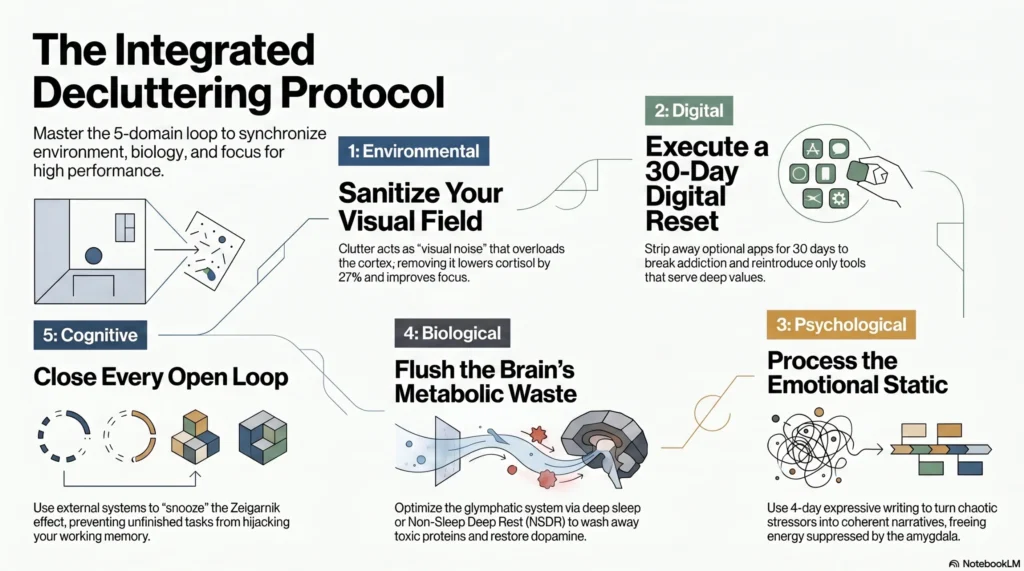
The process of decluttering the brain is a literal biological requirement facilitated by the glymphatic system. This recently discovered pathway acts as a “janitorial” service, using cerebrospinal fluid (CSF) to flush out toxic proteins like amyloid-β and tau—byproducts of daily neural activity linked to neurodegenerative decline.
This system is 60% more efficient during Stage 3 NREM (deep sleep). During this phase, brain cells subtly shrink, expanding the interstitial space to allow fluid to flow more freely. Simultaneously, levels of the neurotransmitter norepinephrine decrease, which relaxes the brain’s vessels and facilitates more vigorous fluid exchange. When sleep is disrupted, the brain fails to clear these metabolic byproducts, leading to a measurable increase in “amyloid burden” even after a single night of sleep loss.
Practical Steps for a Nightly Brain Wash
- Maintain a Regular Circadian Rhythm: Consistency supports the natural timing of the glymphatic cleaning cycle.
- Implement a Digital Curfew: Turning off screens 1–3 hours before bed prevents blue light from suppressing melatonin, the hormone that helps initiate the cleaning phase.
- Strict Intake Window: Avoid heavy meals and alcohol at least two hours prior to sleep, as these substances can interfere with natural waste-clearance mechanisms.
2. Neurobiology of Visual Noise: Why Physical Order is Mental Clarity
Physical disorganization is a significant drain on cognitive resources. fMRI data reveal that when your environment is cluttered, your visual cortex is exposed to an excess of stimuli competing for neural representation. This “visual noise” creates a chronic, low-grade elevation of cortisol. Left unchecked, this persistent “fight or flight” response taxes biological resources and is linked to long-term health risks, including Type 2 diabetes and cardiovascular disease.
The mental cost extends to social cognition; a 2016 study found that background clutter significantly reduces the ability to accurately interpret others’ emotional expressions. For some, the act of discarding items is particularly difficult; a landmark Yale University study found that in individuals with hoarding tendencies, throwing things away activates the insula and anterior cingulate cortex (ACC)—the same regions associated with physical pain.
Heuristics for Environmental Control
- The OHIO Rule (Only Handle It Once): Upon receiving a task or item, decide immediately to delete, file, or act on it to prevent it from re-entering your mental loop.
- The One-Minute Rule: If a task (like clearing a dish or filing a document) takes less than sixty seconds, perform it immediately to avoid adding to your “visual noise” burden.
3. Closing the “Open Loops”: Attentional Management as Strategy
Strategic attentional management is the cornerstone of knowing how to declutter your brain; it requires moving from reactive firefighting to the proactive selection of the “vital few.” The brain is plagued by the “Zeigarnik Effect,” a phenomenon in which incomplete tasks occupy more mental space than completed ones, creating persistent tension. To silence this noise, you must apply Greg McKeown’s “90% Rule”: if a task or opportunity does not score a 90 or above out of 100 on your criteria for value, it is a clear “no.”
The Priority Architecture: Eisenhower Matrix Refined
| Matrix Quadrant | Classification | Recommended Action | Psychological Barrier |
| Quadrant 1 | Urgent & Important | Do Immediately | Stress-Induced Tunnel Vision |
| Quadrant 2 | Not Urgent but Important | Schedule | Procrastination on High-Value Work |
| Quadrant 3 | Urgent but Not Important | Delegate/Automate | The “Urgency Trap” (People Pleasing) |
| Quadrant 4 | Neither Urgent nor Important | Delete | Sunk-Cost Bias / Mindless Distraction |
4. The “Non-Sleep Deep Rest” (NSDR) Reboot
Non-Sleep Deep Rest (NSDR), including Yoga Nidra, is a powerful tool for those needing a cognitive “reboot” without a full nap. NSDR guides the brain into a “liminal state” between wakefulness and sleep, which has been shown to restore striatal dopamine levels by as much as 65%. By reducing cortisol and shifting the nervous system into a parasympathetic state, NSDR facilitates a state of “alert yet calm,” which is optimal for learning and memory retention.
The 13-Minute NSDR Protocol
- Body Scanning: Systematically direct attention to different parts of the body to induce deep physical relaxation.
- Breath Pacing: Use intentional, slow breathing to signal the nervous system to transition to a state of rest.
- De-focusing the Mind: Intentionally turn away from analytical thought patterns to allow the brain to enter a restorative liminal state.
5. Narrative Integration: The Pennebaker Writing Protocol
While a “Brain Dump” (like Morning Pages) is useful for clearing immediate tasks, long-term cognitive decluttering requires “Expressive Writing.” Dr. James Pennebaker’s research shows that converting fragmented emotional memories into a coherent narrative reduces the cognitive “static” caused by suppressed thoughts. Putting feelings into words engages the prefrontal cortex (PFC), which helps downregulate the amygdala’s threat response.
| Parameter | Brain Dump (Offloading) | Expressive Writing (Processing) |
| Primary Goal | Clearing working memory of immediate tasks | Cognitive restructuring of memories |
| Neural Mechanism | Offloading extraneous load | PFC activation; amygdala downregulation |
| Outcome | Short-term relief; situational focus | Long-term resilience; immune system boost |
Your 4-Day Clarity Plan
To implement the Pennebaker protocol, write for 15 to 30 minutes each day for 4 consecutive days about a single stressful experience. Express your deepest thoughts and feelings without worrying about grammar. This process allows the brain to “file” the experience, effectively removing it from your current attentional consciousness.
6. The BDNF Factor: Cultivating “Miracle-Gro” for Neural Flexibility
Aerobic exercise is a primary biological modulator of mental clarity. Physical activity elevates levels of Brain-Derived Neurotrophic Factor (BDNF), often referred to as “miracle-gro for the brain.” BDNF fosters neurogenesis in the hippocampus, directly enhancing “Cognitive Flexibility”—your ability to adapt thinking in response to a cluttered information environment. Furthermore, regular exercise reduces pro-inflammatory cytokines, which are biological markers linked to “brain fog” and depressive symptoms.
7. The Waking “Wash”: Meditation and Neurofluid Dynamics
Focused-attention meditation is a non-invasive, waking-state intervention that stimulates the brain’s waste-clearance systems. A study published in the Proceedings of the National Academy of Sciences (PNAS) found that meditation can induce cerebrospinal fluid (CSF) fluctuations similar to those observed during sleep.
Meditation functions through the “Triadic Network Model,” training the Salience Network (SN) to act as a switchboard. It learns to switch the brain’s activity away from the Default Mode Network (DMN)—the system responsible for rumination and “mental chatter”—and toward the Central Executive Network (CEN), which handles focused task execution.
Conclusion: Achieving the Integrated Cognitive State
The ultimate goal of decluttering your brain is to attain the “Integrated Cognitive State.” In this state, your internal narrative is coherent, your environment is visually quiet, and your biological waste-clearance systems are functioning at peak efficiency. Achieving this requires more than just tidiness; it requires the “disciplined pursuit of less”—a commitment to protecting your most valuable asset: your own mind. By adopting these science-backed protocols, you secure a decisive competitive advantage in an age of distraction.
Frequently Asked Questions
Can meditation replace sleep for brain cleaning? No. While focused-attention meditation can stimulate CSF dynamics similar to those in sleep, it cannot replicate the specific cell shrinkage that occurs during Stage 3 NREM sleep, which is required for maximal glymphatic efficiency.
How does age affect the brain’s ability to declutter? As individuals age, the quality of deep sleep typically decreases. This leads to a higher “PVS (perivascular space) burden,” where the glymphatic system spends less time in its active clearance phase, potentially increasing the risk of neurodegenerative protein accumulation.
Is a “brain dump” the same as a writing protocol? No. A “brain dump” is designed for the short-term offloading of immediate tasks to free up working memory. A writing protocol (like Pennebaker’s) involves cognitive restructuring of emotional memories to promote long-term psychological well-being and resilience.



Leave a Reply