
Table of Contents
In our high-pressure, always-connected world, many of us have experienced mindless eating. You might find yourself scrolling through your phone during lunch or eating under the stress of a deadline, only to look down and realize your food is gone, with no memory of its taste or texture. This disconnected state isn’t just a bad habit; it is a neurological state where the brain bypasses internal signals of satisfaction, weakening the neural pathways that regulate your appetite.
By transitioning from “automated eating” to a science-backed mindful eating and portion-control approach, you can begin the process of “brain rewiring” to improve both your mood and metabolic health. This approach moves beyond restrictive dieting to focus on the intersection of neurobiology and behavior, teaching you how to use interoceptive awareness—the sensing of internal bodily signals—to regain control over your relationship with food and your physiology.
The “Cephalic Phase”: Why Your Digestion Starts Before the First Bite
Digestion does not begin when food hits your stomach; it begins in the brain. The “Cephalic Phase” refers to the anticipatory neural responses that prepare the gastrointestinal tract for a meal. When you see, smell, or even think about food, sensory receptors send signals to the Medulla Oblongata—the integration center in the brainstem—which then activates the parasympathetic nervous system.
This is a “feedforward control” mechanism. Transmitting signals primarily via the Vagus nerve—the “superhighway” between your gut and brain—your system prepares for the predictable demand of food. Even before ingestion, your body increases the production of salivary amylase to break down carbohydrates and prompts the stomach to secrete hydrochloric acid and enzymes. This synchronization ensures your system is chemically primed to handle food efficiently the moment it arrives.
How to Prime Your System for Better Digestion
To effectively trigger the cephalic phase and activate your “rest and digest” mode, follow these steps before your first bite:
- The Three-Breath Reset: Before eating, take three deep breaths. This shifts the nervous system from a stressed “fight or flight” state into a receptive, aware state, signaling the Medulla Oblongata to begin digestive prep.
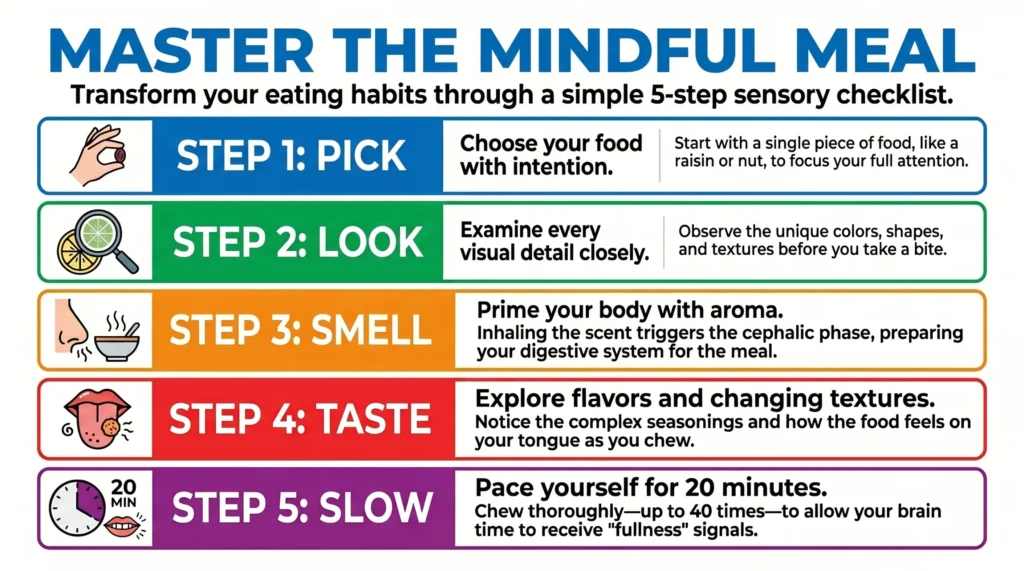
- The Sensory Scan: Spend 30 seconds noticing the temperature, texture, and aroma of your food. This intentional focus activates the interoceptive awareness system, preparing the brain to receive satiety signals later in the meal.
Escaping the “Dopamine Trap”: It’s Not a Lack of Willpower
Many struggle with cravings for ultra-processed foods, often blaming a moral failing. However, neuroscience reveals that foods engineered to be high in sugar and fat hijack the brain’s reward system, specifically the Ventral Tegmental Area (VTA) and the Nucleus Accumbens. These regions form the mesolimbic dopamine pathway, which releases massive dopamine surges that mark the behavior as a survival priority.
Over time, these excessive spikes cause the brain to adapt by reducing receptor sensitivity. This desensitization weakens the prefrontal cortex—the area responsible for impulse control and rational decision-making. In this state, the prefrontal cortex “takes a backseat” to the reactive amygdala, making “willpower” a victim of rewired circuitry. The brain begins to prioritize instant gratification over long-term well-being, not because of a lack of character, but because the neural hardware has been compromised.
Steps to Break the Instant Gratification Loop
You can retrain your brain to seek satisfaction from healthier sources and support your prefrontal cortex:
- Prioritize Tyrosine-Rich Foods: Dopamine is synthesized from the amino acid tyrosine. Consuming foods like eggs, fish, chicken, nuts, and seeds provides the building blocks for balanced, sustainable dopamine levels.
- Engage Natural Reward Pathways: Replace food-based “quick fixes” with natural dopamine boosters like music, a brisk walk, or time spent in nature.
- Social Connection: A heartfelt conversation or a hug triggers dopamine through social bonding, helping to satisfy the reward system without a trip to the pantry.
Mastering Mindful Eating and Portion Control with the “Hand Method”
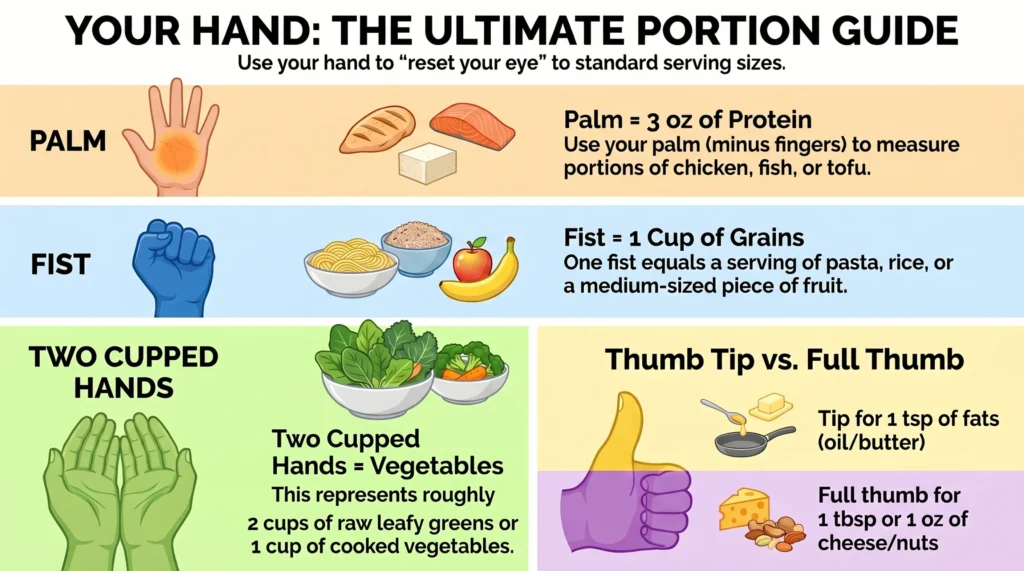
Modern food environments suffer from “portion distortion” and “unit bias”—the tendency to believe that whatever is served on a plate equals a single standard serving. As portions have grown over the decades, our brains have lost track of what the body actually requires. To manage this without the stress of scales or apps, use your hand as a personalized, permanent guide for estimating servings:
- Protein: A serving should be roughly the size of the palm of your hand (approx. 3–4 oz).
- Carbohydrates/Grains: Use a single fist or a cupped hand to estimate a serving (approx. 1/2 to 1 cup).
- Vegetables: Aim for two cupped hands for raw vegetables (approx. 1–2 cups).
- Fats: Use the tip of your thumb (from the first knuckle to the tip) for 1 teaspoon of oils or butter. A full thumb (from the base to the tip) is equivalent to 1 tablespoon.
The “Plate Method” for Balanced Meals
Visually dividing your plate helps ensure nutritional balance and stable energy:
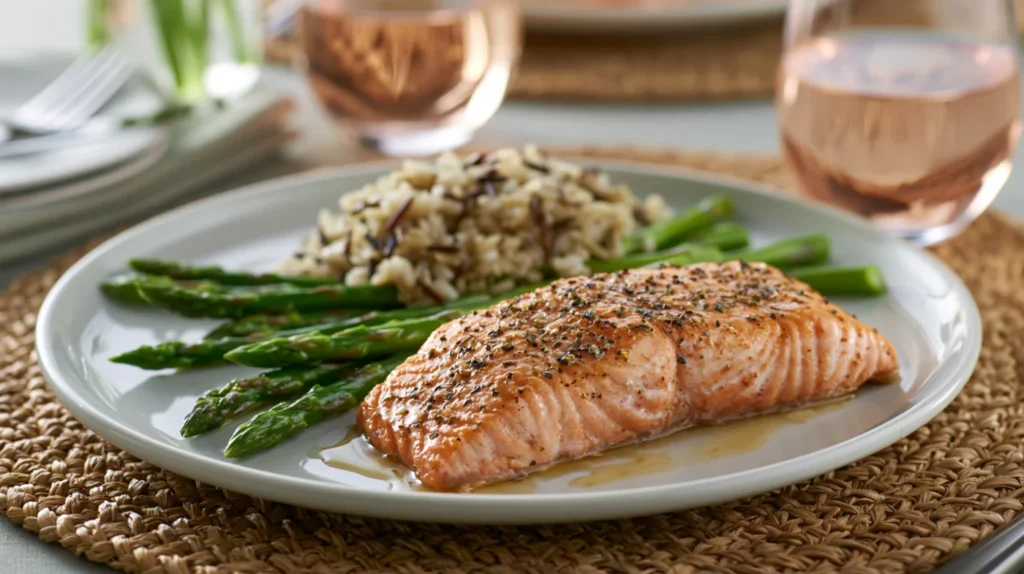
- Fill half of your plate with non-starchy vegetables to maximize fiber and nutrients.
- Dedicate one-quarter to a lean protein source (about the size of your palm).
- Dedicate the final one-quarter to whole grains or starchy vegetables (about the size of your fist).
The Interoceptive Connection: Lighting Up Your Brain’s Command Center
Mindful eating activates the “interoceptive awareness system,” specifically the insula and the anterior cingulate cortex (ACC). The insula processes physical sensations and emotions, while the ACC assists with attention and impulse regulation. When you practice mindfulness at the table, you strengthen these regions, allowing the prefrontal cortex to “take the wheel” back from the amygdala.
Strengthening these pathways improves your executive function and emotional regulation. This neural “muscle building” helps you distinguish between true physiological hunger and the emotional urges driven by boredom or stress.
An Internal Hunger Check-In
Before reaching for a snack, perform a brief audit of your internal signals:
- The Emotional Query: Ask yourself, “Am I physically hungry, or am I eating to manage an emotion?”
- Identify Physical Hunger Cues: Look for reliable biological markers, such as a growling stomach, low energy, shaky hands, or brain fog.
- Contrast with Emotional Markers: Notice if you are feeling “butterflies” in the stomach, tension in the shoulders, or a “trance-like” urge to munch just because food is visible.
The 20-Minute Rule: Synchronizing the Brain and the Gut
There is a physiological lag in satiety signaling. It takes approximately 20 minutes for the Vagus nerve “superhighway” to communicate to the brain that the stomach is full. When we eat quickly, we often bypass this signal entirely, leading to overeating and digestive discomfort. Slowing down allows these biological clocks to synchronize.
Practical “Pace Makers” for Slower Eating
Interrupt your automated eating flow with these high-impact “neuro-hacks”:
- The Non-Dominant Hand Challenge: Eat with your non-dominant hand. This simple pattern interrupt can reduce food intake by approximately 30% by breaking the automated hand-to-mouth flow.
- The “Put It Down” and “Reload” Practice: Place your utensils down between every bite. View your fork as a tool that must be carefully and intentionally “reloaded” only after you have swallowed the previous bite.
- The “Savor” Technique: Before taking a bite, name two adjectives to describe the food (e.g., “crunchy” and “salty”). This forces the brain’s descriptive centers to engage, inserting a necessary pause.
Neuroplasticity: Rewiring Your Relationship with Food in 66 Days
While habits like stress eating have deep neural grooves, your brain possesses neuroplasticity—the ability to form new connections. Research suggests it takes approximately 66 days of consistent practice to form a new habit. The goal is consistency over perfection; your brain builds these pathways through regular repetition, not the occasional flawless performance.
Small Wins for Long-Term Change
Maintain momentum by focusing on manageable progress:
- The Mindful Eating Bingo: Use a “Bingo” approach to track variety and success. Mark off squares for wins like “sat down for lunch,” “noticed a fullness cue,” or “ate with my non-dominant hand.”
- Habit Tracking: Use a simple tracker to visualize your 66-day journey. Even one mindful bite per meal counts as a “rep” that strengthens your prefrontal cortex.
Conclusion
Mindful eating and portion control are not restrictive punishments; they are essential tools for long-term brain health and metabolic stability. By understanding the neurobiology of the dopamine trap and the importance of the Vagus nerve superhighway, you can break the cycle of “automated eating.” These practices empower you to take back control of your impulse centers and reconnect with your body’s natural wisdom, leading to a balanced and resilient relationship with food.
Frequently Asked Questions
What is the difference between a ‘serving’ and a ‘portion’? A serving is a standard, measurable amount used on nutrition labels (e.g., 1 cup or 15ml). A portion is the actual amount of food you choose to put on your plate. Mindful eating helps you align your portion with your body’s actual needs rather than the “unit bias” of what is served.
How does stress contribute to overeating? Stress triggers the release of cortisol, which increases cravings for high-calorie “reward” foods. In this state, the amygdala (emotional center) becomes hyperactive while the prefrontal cortex (rational center) takes a backseat, leading to impulsive, reactive eating.
Can mindful eating help with acid reflux or GERD? Yes. Early neural signals in the cephalic phase help coordinate the tone of the Lower Esophageal Sphincter (LES), the muscle ring that prevents stomach acid from backing up. Mindful eating encourages smaller meals and slower consumption, reducing pressure on the LES and improving overall gastric coordination.

Leave a Reply