

For most individuals embarking on a weight management journey, the initial phase often feels like a sequence of easy victories. However, these victories are frequently followed by the demoralizing wall of a weight loss plateau. This common dilemma is not a failure of willpower, but a failure of strategy rooted in a misunderstanding of energy balance. To succeed long-term, we must move beyond the archaic mindset of chronic deprivation and understand what is a calorie controlled diet in a clinical context: it is a precision-engineered therapeutic tool designed to harmonize energy intake with the body’s dynamic metabolic demands while protecting structural integrity.In this comprehensive guide, we will dissect the sophisticated architecture of human energy expenditure and explain why the quality of your fuel is as critical as the quantity. You will learn the biological science of “adaptive thermogenesis”—the body’s evolutionary defense mechanism that slows metabolism during restriction—and the critical role of nutrient density in maintaining satiety. By the end of this synthesis, you will be equipped to build a sustainable dietary framework that prioritizes metabolic flexibility, spares lean muscle mass, and utilizes data-backed precision rather than restriction to achieve lasting health.
The Architecture of Human Energy Expenditure
To master weight management, one must first view the body not as a static furnace, but as a complex bioenergetic system. Your total energy requirement is known as Total Daily Energy Expenditure (TDEE). This is not a fixed number; it is a composite of four distinct metabolic pillars that fluctuate based on your body composition, hormonal environment, and activity levels.
1. Basal Metabolic Rate (BMR): The Cost of Living
The BMR is the physiological foundation of your metabolism, typically accounting for 60% to 70% of your total daily energy use. This represents the energy required to fuel vital life-sustaining processes at rest. On a cellular level, BMR is driven by high-energy-demand tasks: the firing of neurons, the constant filtration of blood by the kidneys, the mechanical pumping of the heart, and—most notably—ion pumping across cell membranes.
Maintaining the sodium-potassium gradient (via the Na+/K+-ATPase pump) is an immense metabolic drain, as is the constant turnover of cellular proteins and the process of mitochondrial cellular respiration. Because true BMR must be measured under strict laboratory conditions, we often use Resting Metabolic Rate (RMR) as a close clinical proxy. The primary driver of BMR is lean body mass (LBM). Muscle tissue is significantly more metabolically active than adipose (fat) tissue, acting as the “metabolic engine” that determines your baseline burn.
2. Thermic Effect of Food (TEF): The Cost of Processing
Every calorie you consume requires energy to digest, absorb, and store. This is known as the Thermic Effect of Food, or diet-induced thermogenesis. While it typically accounts for 10% of TDEE, this figure is highly dependent on macronutrient composition. For example, protein has a high metabolic cost (20–30%), while carbohydrates (5–10%) and fats (0–3%) are processed much more efficiently by the body.
3. Thermic Effect of Activity (TEA): The Cost of Movement
This represents the calories burned during intentional, structured exercise, such as resistance training or cardiovascular work.
4. Non-Exercise Activity Thermogenesis (NEAT): The Variable Factor
NEAT covers all energy expended for movement that is not formal exercise. This includes everything from walking to the office and performing household chores to fidgeting and maintaining posture. NEAT is the most variable component of TDEE and can vary by as much as 2,000 calories between individuals depending on their lifestyle and occupation.
How to Estimate Your Personal Needs
To transition from theory to clinical application, you must estimate your baseline needs using validated mathematical models. The Mifflin-St Jeor equation is currently considered the most accurate predictor for the general adult population.
Mifflin-St Jeor Formulas:
- Males: BMR = (10 × weight in kg) + (6.25 × height in cm) – (5 × age in years) + 5
- Females: BMR = (10 × weight in kg) + (6.25 × height in cm) – (5 × age in years) – 161
Applying Physical Activity Level (PAL) Multipliers: To find your TDEE, multiply your BMR by the PAL factor that reflects your daily movement:
- Sedentary (1.2): Minimal activity; no structured exercise.
- Lightly Active (1.375): Light exercise/activity 1–3 days per week.
- Moderately Active (1.55): Moderate exercise/activity 6–7 days per week.
- Very Active (1.725): Intense daily exercise or physical labor.
- Extra Active (1.9): Professional athletes or very heavy physical labor.
The “Starvation Reaction” and Adaptive Thermogenesis
A pervasive error in modern dieting is the “crash” approach. When we ask, “what is a calorie controlled diet,” we must distinguish it from severe caloric restriction. When calories are restricted too aggressively, the body initiates a survival process known as adaptive thermogenesis. This is an evolutionary defense mechanism where the body increases its metabolic efficiency to prevent starvation.
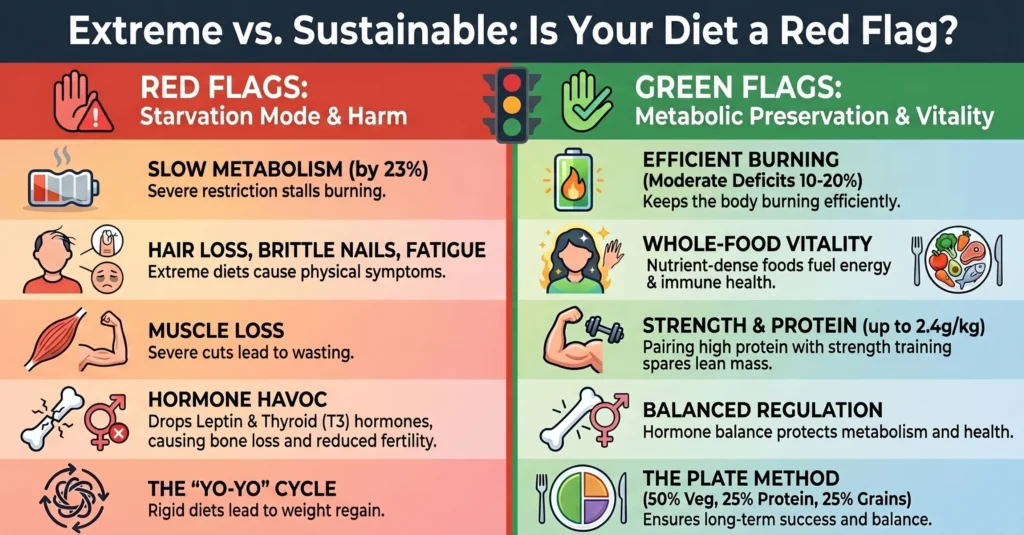
Clinical evidence suggests that severe low-calorie diets can decrease energy expenditure by as much as 23%. This slowdown often persists long after the dieting phase has ended, which explains why roughly 80% of dieters eventually regain the weight. The body downregulates “non-essential” functions—such as heat production and tissue repair—to conserve its fuel stores.
The Hormonal Shift: Leptin vs. Ghrelin
This metabolic defense is mediated by a complex hormonal feedback loop. As fat cells shrink, they secrete less Leptin (the satiety hormone). The hypothalamus interprets falling leptin levels as a starvation signal, triggering intense hunger and a reduction in thyroid activity (T3/T4). Simultaneously, Ghrelin (the hunger hormone) rises, creating a biological drive to eat that can override voluntary restraint. A successful calorie-controlled diet must be moderate enough to navigate these hormonal defenses without triggering a full-scale “starvation reaction.”
Nutrient Density vs. Energy Density
In weight management, the volume of food consumed is often more important for satiety than the absolute calorie count. Research confirms that the human body feels full based on the volume and weight of food consumed rather than its energy yield.
- Energy-Dense Foods: These pack high calories into a small volume (e.g., oils, processed snacks, sweets). They are easily overconsumed because they fail to sufficiently activate gastric stretch receptors.
- Nutrient-Dense Foods: These provide high concentrations of vitamins, minerals, and fiber relative to their calories (e.g., leafy greens, berries, lean proteins).
The Caloric Cost of Macronutrients
Understanding the specific energy yield per gram is essential for precise control:
- Fat: 9 calories/gram (Highest energy density)
- Alcohol: 7 calories/gram (Significant energy with zero nutrition)
- Carbohydrates: 4 calories/gram
- Protein: 4 calories/gram (Highest thermic effect)
- Fiber: ~2 calories/gram (Helps reduce total energy density)
Building a Nutrient-First Plate: The Plate Method
A sustainable calorie-controlled diet utilizes visual heuristics like the “Plate Method” to ensure both satiety and metabolic support:
- 50% Non-Starchy Vegetables: High volume and fiber to trigger fullness.
- 25% Lean Protein: Essential for muscle sparing and high TEF.
- 25% Whole Grains or Starches: Provides controlled glucose for sustained energy.
The Five Hidden Dangers of Severe Restriction
While a moderate deficit can be therapeutic, extreme restriction is clinically hazardous. Clinical research highlights five distinct areas of concern that arise when one moves from a calibrated diet to extreme deprivation.
1. Persistent Metabolic Slowdown
Severe dieting creates a permanent shift in metabolic efficiency. This is not just a temporary dip; the lower metabolic rate can remain even after weight is regained, creating a “yo-yo” cycle that makes future weight management exponentially harder.
2. The “DRI Paradox” and Nutrient Deficiencies
A critical finding in the Damms-Machado study revealed a “DRI Paradox.” Even when obese subjects were put on a standardized 800 kcal formula diet designed to cover 100% of the Dietary Reference Intakes (DRI), they still manifested or worsened deficiencies in Vitamin C, Zinc, and Lycopene. This suggests that standard recommendations (DRI) intended for the general population do not apply during weight loss in obese individuals due to high oxidative stress and the “unbalanced dispersal of lipophilic compounds” in the fat tissue.
3. Fertility and Hormonal Issues
Reproductive function depends on energy availability. In women, extreme restriction suppresses Luteinizing Hormone (LH) and estrogen. In men, testosterone levels may plummet. This is the body’s way of “shutting down” the energy-intensive process of reproduction during a perceived famine.
4. Irreversible Bone Health Compromise
Low levels of reproductive hormones (Estrogen/Testosterone) combined with a spike in the stress hormone Cortisol lead to a double-threat to bone health: increased bone breakdown and reduced bone formation. This can lead to a reduction in bone density that is often irreversible, significantly increasing fracture risk.
5. Immune Suppression and Inflammation
The link between caloric restriction and immunity is profound. Chronic inflammation in obesity often triggers the release of hepcidin, a protein that inhibits iron absorption. This is why many dieters feel fatigued; it’s not just the calories, it’s the inflammatory-driven iron deficiency. Furthermore, a study of athletes in leanness-focused disciplines found they were twice as likely to be sick compared to their peers, as the body lacks the energy required to fuel the immune response.
Why Protein and Resistance Training are Non-Negotiable
A major risk of weight loss is that the body does not distinguish between burning fat and breaking down muscle. In interventions that rely solely on diet, muscle loss can account for 25% of total weight lost. This loss of muscle tissue—your primary metabolic engine—leads to a downregulation of muscle protein synthesis and a lower BMR.
To counter this, a high-protein intake (1.4 to 2.4 g/kg of body weight) combined with resistance training is required. This provides both the “anabolic stimulus” (training) and the building blocks (amino acids) to protect lean mass.
The Thermic Advantage
As a Health Research Synthesizer, I emphasize that protein also offers a “metabolic bonus.” Because its TEF is 20-30%, a significant portion of its energy is “wasted” as heat during digestion, which helps keep the metabolic rate elevated even in a deficit.
Protecting Your Metabolic Engine:
- Prioritize 20-30g of protein per meal: Focus on an even distribution to maximize the anabolic signal.
- Resistance Train 2-3 Days/Week: This sends a mechanical signal to the body that muscle is “essential” for survival.
- Never eat below your BMR: This is the hard floor. Eating below your BMR is the quickest way to trigger hormonal downregulation.
Lessons from the National Weight Control Registry (NWCR)
The NWCR is the largest prospective investigation of long-term successful weight loss maintenance, tracking over 5,000 individuals who have lost at least 30 lbs and kept it off for over a year. Their habits provide a roadmap for long-term calorie control.
Core Success Habits of “Maintainers”:
- 78% eat breakfast daily: This habit is associated with higher physical activity levels and better energy balance throughout the day.
- Consistency is King: They follow the same eating routine on weekends as they do on weekdays, avoiding the binge-restrict cycle.
- 60 Minutes of Activity per day: While structured exercise (TEA) is good, consistent daily movement is the hallmark of those who keep the weight off.
- Regular Self-Monitoring: 75% weigh themselves at least once a week. This allows for small course corrections before a 2lb gain becomes a 20lb gain.
Metabolic Flexibility and Chronic Disease Remission
When evaluating what is a calorie controlled diet, we must view it as a metabolic reset. A key goal is “Metabolic Flexibility”—the ability of your mitochondria to switch fuel sources efficiently between fats and carbohydrates. In obesity and Type 2 Diabetes (T2D), individuals become “metabolically inflexible,” struggling to burn fat and leading to the accumulation of “intramyocellular lipids” (fat inside muscle cells) which drives insulin resistance.
The T2D Breakthrough: The DiRECT Trial
The landmark DiRECT trial found that intensive weight loss could induce Type 2 Diabetes remission. The mechanism involves the mobilization of “ectopic fat”—fat stored where it doesn’t belong, specifically in the liver and pancreas. When this fat is reduced, these organs can resume normal function. Remission (maintaining blood sugar without meds) was most successful in those who lost more than 15kg (33 lbs) within the first 5-6 years of their diagnosis.
Conclusion: Sustainability Over Speed
Ultimately, calorie control is a dynamic therapeutic tool, not a temporary sentence of punishment. Success is found in the “Goldilocks Zone”: a deficit large enough to mobilize body fat but moderate enough to spare muscle and avoid hormonal shutdown. Long-term metabolic health is not built on the speed of the loss, but on the preservation of the metabolic engine. By prioritizing nutrient density and protein, and by respecting the biological “floor” of your BMR, you can navigate the complexities of energy balance and move beyond counting calories to truly counting nutrients.
Frequently Asked Questions
What is the difference between BMR and TDEE? BMR (Basal Metabolic Rate) is the energy required to keep your cells alive and your organs functioning while you are asleep or at rest. TDEE (Total Daily Energy Expenditure) is the sum of your BMR plus the energy used for digestion (TEF), daily movement (NEAT), and structured exercise (TEA). TDEE is what you actually burn in a 24-hour period.
How can I tell if my calorie restriction is too severe? Clinical “red flags” include constant fatigue, hair loss, brittle nails, feeling cold in warm rooms, and the loss of a menstrual cycle. From a data perspective, the Cleveland Clinic suggests that an unexplained loss of more than 5% of your body weight or 10 pounds in 6-12 months is a medical red flag that should be evaluated, even if you are intentionally dieting.
Can a calorie-controlled diet actually reverse Type 2 Diabetes? Yes. Clinical evidence from the DiRECT trial shows that a loss of 15kg (33 lbs) can mobilize ectopic fat from the pancreas and liver, allowing for T2D remission in many patients. This is most effective when addressed early in the diagnosis.
Why do I feel tired even if I’m hitting my vitamin targets? This may be due to the “DRI Paradox” or oxidative stress. During significant weight loss, your body’s demand for certain micronutrients like Vitamin C and Zinc increases beyond standard recommendations. Additionally, chronic inflammation can cause the release of hepcidin, which blocks iron absorption, leading to fatigue regardless of your total caloric intake.



Leave a Reply